With the GP machinery of Chapter Chapter 9 in hand, this chapter builds the practical surrogate-driven workflows that make structural estimation tractable at research scale. We start with the deep-surrogate pseudo-state pattern, in which the structural parameter is concatenated into the network input so that a single trained policy net replaces one full model re-solve per with one forward pass. We illustrate the pattern on a Black--Scholes example, then put it to work for Simulated Method of Moments (SMM) on the Brock--Mirman growth model, layer a Gaussian-process surrogate on top of the moment map for high-throughput bootstrap and Bayesian post-processing, and close with the natural extensions to indirect inference and simulation-based inference. The econometric foundations are McFadden (1989), Pakes & Pollard (1989), Lee & Ingram (1991), Duffie & Singleton (1993), and Gourieroux et al. (1993); the surrogate logic follows the deep-surrogate and GP-surrogate pipelines in Chen et al. (2026) and Scheidegger & Bilionis (2019). Recent applications of the same surrogate-then-estimate move include heterogeneous-agent estimation Kase et al., 2022, search-and-matching Payne et al., 2025, and climate-economy policy design and uncertainty quantification Kübler et al., 2026Friedl et al., 2023.
Before the current deep-learning boom, neural networks were already studied as nonlinear sieve estimators in econometrics, with a rigorous asymptotic theory developed in parallel with the approximation-theory results of Chapter Chapter 1. Chen & White (1999) establish convergence rates and asymptotic normality for single-hidden-layer network estimators, and Chen (2007) integrates that line into the broader sieve treatment of semi-nonparametric models defined by conditional moment restrictions, which is precisely the structural-estimation setting of this chapter. The modern continuation of this program uses deep architectures for efficient estimation in nonparametric instrumental-variable models Chen et al., 2021. The pipelines developed below should be read as the implementation-side companion to that theoretical tradition: the sieve literature tells us when neural-network estimators consistently identify deep structural parameters; the surrogate pipelines tell us how to make the resulting estimators cheap enough to deploy at research scale.
10.0.1Motivation: The Computational Bottleneck
Every workflow this chapter targets puts an expensive numerical solve inside an outer loop. For estimation, uncertainty quantification, and optimal policy design, the outer loop runs over a parameter or scenario vector and the inner solve is a full model solution, a Bellman fixed point, a PDE solve, or a Monte Carlo run that costs seconds to hours, repeated at the 103 to 106 outer iterations these tasks demand.
For dynamic programming, the outer loop is the Bellman iteration itself: at iteration the inner “solve” is one evaluation of the operator at a state , which itself requires a constrained nonlinear program over controls plus a quadrature over the next-period shock, then a global fit of to those labels (Section 9.6.1 of Chapter Chapter 9). In both cases the obstacle is the same: the per-inner-solve cost times the per-outer-iteration count.
The key insight is that since we own the structural model, we can generate training data by solving the model on a carefully chosen set of input configurations (a design of experiments). A cheap-to-evaluate function approximator trained on this synthetic dataset, a surrogate model, then replaces the expensive original model for all downstream tasks. Any suitable function approximator can serve as the surrogate; the right choice depends on the dimensionality of the input space and the cost of generating each training point.
10.0.1.0.1Cutting out the outer loop.
The point of a surrogate is to break this nesting. One pays a one-time offline cost: pick a design of experiments , solve the model at those configurations, and fit a surrogate to the results. From then on the expensive inner solve is gone, and the estimation, uncertainty-quantification, or policy-search outer loop evaluates a function that costs microseconds and returns exact gradients, so it can run at the 103 to 106 scale those tasks need. The model is solved at a handful of configurations and the surrogate interpolates between them, which is almost always far cheaper than re-solving at every new ; Figure Figure 10.1 contrasts the two workflows. The surrogate-based SMM estimation developed below and the surrogate-then-optimize policy search of Chapter Chapter 11 are both instances of this move, as is the GP value-function iteration of Section 9.6 in Chapter Chapter 9, where the “outer loop” is the Bellman iteration itself; there the surrogate is refit every Bellman step and the “offline” phase becomes a per-iteration update.
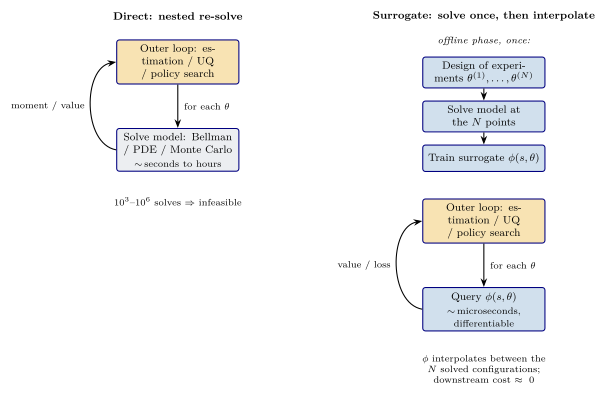
Figure 10.1:Why surrogates help. Left: structural estimation, uncertainty quantification, and optimal policy design are outer loops over a parameter vector , and the direct implementation re-solves the full model inside the loop, so the cost scales with the number of outer iterations times the per-solve cost. Right: a surrogate moves that solve into a one-time offline phase, solving the model only at a design of experiments and fitting ; the outer loop then queries a cheap, differentiable interpolant. The saving grows with both the number of outer iterations and the per-solve cost. The same picture applies to GP value-function iteration with the outer loop relabeled as the Bellman iteration and the inner solve as one evaluation; the offline phase is then replaced by a per-iteration GP refit at modest design size.
10.0.1.0.2Two surrogate strategies.
This course covers two complementary approaches:
Deep neural network (DNN) surrogates are best suited for high-dimensional settings ( inputs) where training data can be generated in large quantities, for example when each model solve takes seconds or when closed-form solutions exist. DNNs scale gracefully with dimensionality, can be trained via mini-batch SGD on millions of samples, and provide exact gradients via automatic differentiation. Chen et al. (2026) formalize this approach and demonstrate speedups of several orders of magnitude for option pricing (the same surrogate-for-finance idea was implemented earlier with adaptive sparse grids by Scheidegger & Treccani (2018)); Friedl et al. (2023) apply it to uncertainty quantification in high-dimensional integrated assessment models.
Gaussian process (GP) surrogates are preferable for intermediate-dimensional settings (--15) where each training point is numerically expensive, for example solving a full DSGE model at one parameter configuration may take minutes or hours. GPs are data-efficient: the Bayesian posterior extracts maximum information from each observation. Crucially, the posterior variance provides a built-in uncertainty estimate that can guide where to evaluate next, enabling Bayesian Active Learning (BAL) strategies that allocate the computational budget optimally Scheidegger & Bilionis, 2019.
Table 10.1:Two complementary surrogate strategies. DNN surrogates are attractive when the input dimension and available training set are large; GP surrogates are attractive when each simulator call is expensive and calibrated posterior uncertainty is useful for active learning.
| DNN surrogate | GP surrogate | |
|---|---|---|
| Best for | high-dim. (), large | moderate-dim. (), small |
| Data efficiency | data-hungry; wants a large training set | data-efficient; informative from a small one |
| Key advantage | scales to very high via SGD | built-in UQ and active learning |
Table Table 10.1 summarizes the main trade-off. The two approaches are not mutually exclusive: one can use a GP to build an initial low-data surrogate with uncertainty estimates, and later switch to a DNN when more training data becomes available. A detailed comparison covering computational cost, gradient access, and further trade-offs is given in Section Section 9.4 of Chapter Chapter 9, where it sits naturally alongside the GP machinery itself.
10.0.1.0.3Speed gains.
This is the payoff sketched in Figure Figure 10.1: regardless of whether a DNN or GP is used, once the surrogate is trained the per-iteration cost of the downstream outer loop, estimation, sensitivity analysis, or optimal policy design, collapses to a function evaluation. Chen et al. (2026) report speedups of several orders of magnitude for option pricing, where evaluating the DNN surrogate replaces expensive FFT-based Fourier inversion (their Bates-model benchmark documents two-to-three orders of magnitude over the numerical pricing baseline). As a rough rule of thumb, the gain scales with the cost of the underlying pricing routine: the orders-of-magnitude gains arise for models requiring a PDE solve (roughly 1 ms/eval 1 s/eval through a surrogate) or high-dimensional Monte Carlo, regimes in which 103-- speedups are typical. The gains are even larger for gradient computations: while finite-difference gradients require model evaluations (one per parameter), the gradient through the surrogate (autograd for DNNs, closed-form for GPs) requires only a single pass, regardless of the number of parameters.
10.0.2Pseudo-States: Parameters as “State” Variables
The central innovation of the deep surrogate framework is to treat model parameters as additional “pseudo-state” variables:
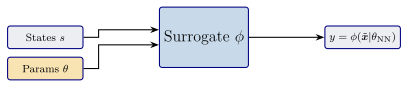
Figure 10.2:Pseudo-state surrogate architecture. Economic states and model parameters are concatenated into the augmented input and fed to a single approximator with weights , yielding a target quantity (price, policy, moment) as a continuous, differentiable function of both the state and the parameter vector. After one offline training pass, the surrogate is queried instantly across the parameter space without re-solving the original model.
The surrogate is trained once over the full augmented space and can then be queried instantly for any parameter configuration, without re-solving the model. This is fundamentally different from simply re-running the model: the surrogate provides a continuous, differentiable mapping from parameters to outputs, enabling gradient-based optimization and uncertainty propagation that would be impossible with the original model. Figure Figure 10.2 sketches this concatenated input.
Scheidegger & Treccani (2018) achieve the surrogate-for-finance idea with adaptive sparse grids; Friedl et al. (2023) apply the surrogate idea to uncertainty quantification in integrated assessment models of climate change; Chen et al. (2026) demonstrate speedups of several orders of magnitude for option pricing with the deep-surrogate approach.
10.0.2.0.1Comparison of approximation methods.
The surrogate approach is one of several function approximation strategies used in computational economics. Table Table 10.2 situates it relative to alternatives.
Table 10.2:Common approximation methods in computational economics. Grid and polynomial methods are transparent but become difficult in high dimension; DNN and GP surrogates trade direct grid structure for sample-based learning and repeated fast evaluation.
| Method | Max dim. | Smoothness | Parametric | Differentiable |
|---|---|---|---|---|
| Cartesian grids | any | no | no | |
| Sparse grids | needed | no | limited | |
| Chebyshev polynomials | smooth | yes | yes | |
| DNN surrogate | any | yes | yes (autograd) | |
| GP surrogate | ^^ | kernel-dependent | no | yes (closed-form) |
10.0.2.1Worked Example: Black--Scholes Surrogate
To illustrate the surrogate pipeline concretely, consider the European call option pricing problem from Section Section 7.8. In the PINN approach (Chapter Chapter 7), the network learned the option price by minimizing the Black--Scholes PDE residual; no training data were needed, only the differential equation. The surrogate approach takes the opposite route: we generate training data by evaluating the closed-form Black--Scholes formula at a design of experiments, and train a neural network to interpolate this data.
Specifically, we sample input tuples from a Latin Hypercube design over the ranges of interest and evaluate the analytical price at each. The surrogate is then trained via standard supervised learning:
Once trained, the surrogate provides instant evaluation at any in a single forward pass, instant Greeks (, , Vega, etc.) via a single backward pass, and gradient-based implied volatility calibration, none of which require re-solving the PDE. The key contrast with the PINN is that the surrogate requires solved training data (here from the analytical formula; in general, from a numerical solver), but in return it treats the model parameters as inputs, enabling re-evaluation across the entire parameter space without re-solving. This is precisely the “pseudo-state” idea of the previous section. See the companion notebook 01_Surrogate_Primer.ipynb for the full implementation.
10.0.3Brock--Mirman with Parameters as Pseudo-States
The stochastic Brock--Mirman model is the partial-depreciation model from Chapter Chapter 2:
We write for TFP persistence to avoid overloading , which elsewhere denotes neural-network parameters. The Python notebooks still use the variable name rho; mathematically, that code variable corresponds to .
The network outputs a savings rate, the fraction of current output that is invested. In the single-parameter exercise,
with calibrated to 0.96. In the joint exercise the input becomes . In either case, recover
Because and , this parameterization enforces , , and gross investment by construction, so the resource constraint and the non-negativity of investment hold automatically and the partial-depreciation Euler equation (10.6) applies as written, with no extra multiplier.[1]
10.1Training uses the same Euler equation as Chapter Chapter 2, but the residual is evaluated jointly over states and parameter draws. With partial depreciation, $$\frac{1}{C_t}
\beta,\E{\frac{1-\delta+\alpha z_{t+1}K_{t+1}^{\alpha-1}}{C_{t+1}}}.$(z_i,K_i,\theta_b)\theta_b=\varrho_b\theta_b=(\beta_b,\varrho_b)$ in the joint exercise, the companion notebooks form the relative residual
where , , , and is computed by feeding back through the same network. The expectation over is approximated by Gauss--Hermite quadrature (Section Section 2.6). The relative form is preferred to the equivalent absolute residual because dividing by the consumption ratio makes the loss scale-free across samples; the two forms share the same zero set but the relative form is better conditioned under FP32 forward passes. A representative training loss is
The outer sum over is the pseudo-state trick: one network learns a family of policies over the whole parameter rectangle.
10.1.1Simulated Method of Moments
The pseudo-state surrogate is what makes SMM cheap. Without it, every objective evaluation would re-solve the structural model. With it, the trained policy network and simulator define a fast deterministic map once the simulation design is fixed.
The Simulated Method of Moments (SMM) estimates structural parameters by matching model-implied moments to their empirical counterparts. The method was developed as an extension of the Generalized Method of Moments (GMM) to settings where the moment conditions do not have a closed-form expression but can be computed via simulation McFadden, 1989Pakes & Pollard, 1989Lee & Ingram, 1991Duffie & Singleton, 1993. A closely related approach is indirect inference Gourieroux et al., 1993, which matches the parameters of an auxiliary model rather than raw moments.
In quantitative macro and finance, the same simulated-moments logic is especially useful in sovereign default and incomplete-markets environments, where likelihood-based estimation is either unavailable or prohibitively expensive Arellano, 2008.
Let denote a vector of sample moments computed from observed data (e.g., mean capital, output variance, consumption autocorrelation), and let denote the corresponding moments simulated from the model at parameter value . The SMM estimator solves:
where is a symmetric positive definite weighting matrix.
10.1.1.0.1The role of the weighting matrix .
The matrix controls how much weight each moment (and each pair of moments) receives in the objective. To build intuition, consider three common choices:
Identity weighting (): all moments receive equal weight. The objective reduces to the unweighted sum of squared deviations, . This is simple but inefficient: moments measured with high precision receive the same weight as noisy moments.
Diagonal weighting (): each moment is scaled by the inverse of its estimated variance. This corrects for differing units and precision.
Optimal weighting: the inverse of the covariance matrix of the moment discrepancy . If the simulation noise is negligible, this is well approximated by the inverse covariance of the empirical moments. With independent simulated panels of the same length as the data and replications, the covariance is approximately , so the optimal weight is proportional to but the scale matters for the -statistic below.
With identity weighting, the criterion is the sum of squared moment deviations; with inverse discrepancy-covariance weighting, it is the squared Mahalanobis distance between simulated and empirical moments.
10.1.1.0.2Consistency and efficiency.
Under standard regularity conditions, the SMM estimator is consistent: as the data sample size . Identification requires more than the usual moment count: locally, the moment Jacobian must satisfy the rank condition
which is necessary for local identification. Note that full column rank is necessary but not sufficient: when the smallest singular value of is close to zero (a near-singular Jacobian), the parameter is only weakly identified in finite samples even though the rank condition formally holds. Global identification additionally requires the population value of the empirical moments, , to be matched at a unique , i.e., has a unique solution in ; the rank condition is the local-curvature implication of that uniqueness. Let , and let denote the asymptotic covariance of . The large-sample distribution is
For independent simulated panels each of length (with a relative-length factor), . The classroom benchmark used below sets (simulated panels of the same length as the data), giving the familiar . As , the extra simulation variance vanishes and ; the factor itself tends to one, not zero. The efficient SMM weight is . See Duffie & Singleton (1993) for the corresponding large-sample theory in the simulated-moments setting.
10.1.2The SMM Workflow in the Exercise
The exercise uses a deliberately simple synthetic-data workflow so that the econometric logic is transparent. First, choose a true parameter and simulate a time series from the trained pseudo-state surrogate. These observations play the role of data. Second, for each candidate parameter, re-simulate the model with the same burn-in length, simulation horizon, initial state, and shock seed. Third, compute a small vector of economically interpretable moments and minimize the quadratic SMM criterion with identity weighting.
10.1.2.0.1Single-parameter persistence exercise.
Notebook lecture_15_03_Structural_Estimation_BM.ipynb calibrates , sets , and estimates . Let denote a simulated sample at candidate persistence . The estimator uses three moments:
All three moments are computed on the raw simulated time series with no detrending or demeaning step, and and denote sample standard deviation and sample autocorrelation evaluated directly on the simulated panel. The output autocorrelation is the most direct persistence moment. The volatility moment should be interpreted as an empirical simulated moment, not as the level-variance formula. For the AR(1) shock,
so the familiar amplification applies to the level of log productivity, not to first differences. The notebook also reports the mean savings rate as a diagnostic and correctly treats it as nearly uninformative for ; it is masked out of the SMM criterion in the scalar exercise and used only for visual identification checks.
10.1.2.0.2Joint exercise.
Notebook lecture_15_03b_Structural_Estimation_BM_Joint.ipynb estimates , with and . It uses four candidate moments: mean savings, growth volatility, consumption-growth autocorrelation, and output autocorrelation. The shallow-ridge two-moment specification retains to expose the partial-identification ridge in the criterion surface; the over-identified specification uses all four moments and collapses the ridge around the synthetic truth. Formally the two-moment case is just-identified (), so we avoid the econometric term weak identification (which refers to a near-singular Jacobian asymptotic regime) and use shallow-ridge or partially-identified for what the criterion-surface picture actually shows.
10.1.2.0.3A deterministic objective.
Because the same initial condition and random seed are used for every candidate , the map is deterministic in the notebooks. This is still standard SMM; the fixed seed is a common-random-numbers device that removes irrelevant simulation noise while we study identification and optimization. In more realistic estimation exercises one averages over multiple replications or increases the simulation length to make Monte Carlo noise negligible. One consequence is worth stating explicitly: because the synthetic data come from the trained surrogate evaluated at the true parameter, and every candidate evaluates the same shock sequence, the SMM criterion attains a near-zero minimum at the truth. This is a clean self-consistency test of the surrogate-SMM pipeline, not a claim about the size of the criterion one would see with real data and independent simulation draws.
10.1.2.0.4Implementation.
The single-parameter estimation routine proceeds in two steps:
Evaluate the SMM objective on a coarse grid over (matching the notebook’s grid bounds) to verify that the criterion is well behaved and to visualize identification.
Refine the minimizer with a bounded scalar optimizer (e.g. Brent’s method).
The joint notebook maps the 2D criterion on a grid, then refines from the grid minimizer using bounded Nelder--Mead. Since the policy surrogate has already been trained, each evaluation of requires only a forward simulation, not a full re-solution of the dynamic program.
10.1.2.0.5Interpretation.
If the moments are informative about , the objective should be minimized close to the synthetic truth. In the scalar notebook, is very close to 0.90 and the fitted policy functions at and nearly overlap. The joint notebook shows the additional lesson: point estimates can be accurate while the criterion still has weak curvature along one parameter direction, which is why contour plots and Jacobian diagnostics matter. Figure Figure 10.4 in Section 10.1.4 below visualizes both specifications and is worth looking at now to fix the geometric picture in mind.
10.1.3Practical Considerations
10.1.3.0.1Moment selection and identification.
The choice of moment conditions is critical for identification. In the scalar exercise, autocorrelation moments identify sharply, while the mean savings rate is nearly flat in . In the joint exercise, the mean savings rate carries most of the information about , while persistence moments carry most of the information about . More generally, the number of moments must weakly exceed the number of parameters (), and the selected moments should move in economically distinct ways as parameters vary.
10.1.3.0.2Weighting.
The exercise uses so that the objective is easy to read. In applications, one usually moves to two-step SMM: first estimate with identity weighting, then estimate the covariance matrix of the moment discrepancy and set in a second pass. This corrects for different moment scales, moment correlations, and any non-negligible simulation noise. The two-step estimator is asymptotically efficient under correct specification and the usual GMM regularity conditions Duffie & Singleton, 1993; under misspecification, the optimal- estimator can have larger finite-sample mean-squared error than identity weighting, because the efficient weighting is calibrated against the wrong moment-discrepancy distribution.
10.1.3.0.3Simulation design.
The notebook fixes the burn-in length, horizon, initial state, and shock sequence across all objective evaluations. This is important because otherwise the optimizer would chase simulation noise rather than structural differences across parameter values. In larger empirical applications, the same idea appears as common random numbers (CRN) or replicated simulations: both are classical variance-reduction techniques in stochastic simulation Glasserman, 2004, and within the simulated-moments setting McFadden (1989) emphasized fixing the simulated draws across parameter values to make the moment objective a smooth function of rather than a noisy step function (the asymptotic theory of optimization estimators with simulation is developed in Pakes & Pollard (1989)). The geometric intuition is simple: if every candidate parameter value is evaluated against the same draw of innovations, the residual isolates the structural effect of moving from to rather than a Monte Carlo accident.
10.1.3.0.4Identification diagnostics.
A necessary condition for local identification is that the Jacobian has full column rank at the true parameter. In the scalar Brock--Mirman exercise this condition reduces to requiring that at least one selected moment changes with in a neighborhood of the truth. In the joint exercise, the singular values of reveal the weak direction associated with . Plotting the objective profile or contour is therefore already informative: a clear and well-centered U-shape signals useful identifying variation, whereas a flat ridge or a jagged profile indicates weak identification or excessive simulation noise.
10.1.3.0.5Over-identification tests.
When the model is over-identified (), report the standard -statistic at the optimum:
Under correct specification and regularity conditions, is asymptotically when , the inverse covariance of the moment discrepancy. If is used while finite simulation noise remains, the statistic must be scaled accordingly or calibrated by bootstrap. A large indicates either model misspecification, poorly chosen moments, or underestimated sampling uncertainty in moments.
10.1.3.0.6Standard errors and confidence intervals.
In applications, report not only but also uncertainty quantification. A plug-in sandwich estimator is:
where and are estimated at under the equal-length independent-simulation approximation. For small samples, time-series dependence, or highly nonlinear criteria, moving-block or parametric bootstrap intervals are often more reliable than first-order asymptotics.
10.1.3.0.7Weak-identification workflow.
If the smallest singular values of are close to zero, inference based purely on local curvature is fragile. In that case, complement Hessian-based standard errors with profile-criterion diagnostics: vary one parameter at a time (or along weak singular vectors), re-optimize the remaining parameters, and report objective-function contour sets in addition to pointwise intervals.
10.1.4GP Surrogate over the Moment Map
The pseudo-state DEQN of the previous sections turned “one re-solve per candidate ” into “one forward simulation per candidate .” For high-throughput SMM, that second cost is still nontrivial: a bootstrap with resamples needs forward simulations on top of the inner optimisation, joint estimation in dimensions multiplies the budget further, and downstream Bayesian or simulation-based-inference workflows want very cheap evaluations of . This section adds a second surrogate layer, a Gaussian process per moment, on top of the policy net, following exactly the supervised-learning logic of Section 9.6.1.
10.1.4.1The Two-Layer Surrogate Architecture
Recall the DEQN policy net from Section 10.1.1; given , it returns the savings rate as a function of and lets us simulate a length- path in milliseconds. The empirical SMM workflow then maps that simulated path to a moment vector via a fixed numerical recipe (means, standard deviations, autocorrelations).
We now stack a second surrogate on top of this:
one independent GP per moment, with its own kernel and length-scale hyperparameters learned by maximising marginal likelihood on a small design . Once trained, evaluating the SMM objective at any candidate is a single GP forward pass per moment, no simulation required. Bootstrapped CIs and any subsequent Bayesian post-processing then run on the GP, not on the simulator. Figure Figure 10.3 reads the architecture top-to-bottom. A candidate is fed into the DEQN policy net of Section 10.1.1, which is rolled forward for periods to produce a simulated path and its moment vector ; a small design of those simulator labels then trains the second layer of independent moment GPs, after which the SMM criterion is a closed-form quadratic in the GP posterior means. The right-hand column traces the per- cost cascade from seconds-to-hours down to microseconds.
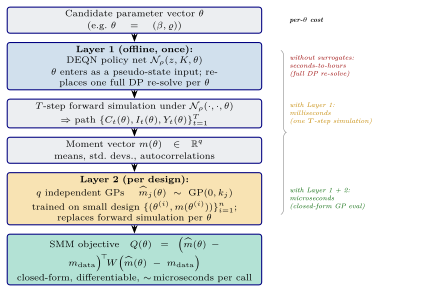
Figure 10.3:The two-layer surrogate architecture for surrogate-based SMM, read top-to-bottom along the chain simulated path moment GPs . Layer 1 is the pseudo-state DEQN policy net of Section 10.1.1: trained once with as an additional input, it replaces the inner Bellman / fixed-point re-solve that direct SMM would require at every candidate parameter, leaving only a -step forward simulation per . Layer 2 is the moment-map GP regression of this section: independent Gaussian processes are fitted to the simulator’s pairs on a small design, after which evaluating the SMM criterion at any new requires only a closed-form GP posterior-mean call per moment. The right-hand annotation traces the per- cost cascade: the direct re-solve costs seconds-to-hours, Layer 1 brings the cost down to milliseconds (one DEQN-driven simulation), and Layer 2 down to microseconds (one differentiable regression call per moment). This is the same supervised-learning-on-an-expensive-oracle pattern as GP-VFI in Section 9.6.1, with the moment vector playing the role the Bellman label plays there; the saving compounds because the high-throughput downstream workflows of SMM, bootstrap, profile likelihood, and simulation-based inference, all live in the bottom box.
10.1.4.1.1Same expensive-oracle structure as VFI.
This is structurally identical to the GP-VFI setup of Section 9.6. There, one design point cost one Bellman maximisation; here, one design point costs one -step forward simulation plus a moment computation. In both cases the regressor sees a small but high-quality training set generated by an expensive numerical procedure, and the GP machinery, marginal-likelihood Occam’s razor for hyperparameters, leave-one-out diagnostics for surrogate health, and Bayesian active learning for adaptive design, applies verbatim.
10.1.4.2Leave-One-Out Validation of the Moment Surrogate
The Cholesky-trick LOO formula (9.20) of Section 9.6.5 delivers a held-out predictive error for each moment GP at zero marginal cost beyond the existing posterior factorisation. A research-scale companion to the core SMM notebooks would track
for every moment and every design size , and pair it with an independent sanity check that evaluates the GP at a fresh interior holdout point never seen during training; agreement between the two RMSEs is the criterion for declaring the moment surrogate trustworthy before any bootstrap or SBI workflow is run on top of it.
10.1.4.3Active Learning of the Moment Surrogate
Two acquisition strategies are natural, matched to the dimensionality of the parameter.
10.1.4.3.1Single-parameter case.
With a scalar , a coarse uniform pilot grid of points can be enriched by active points placed sequentially at locations of largest standardised moment-GP posterior uncertainty,
subject to a minimum-spacing constraint against existing design points. This is the same pure-exploration acquisition used for VFI (9.22), modulo the per-moment normalisation that prevents one large-magnitude moment from dominating the objective.
10.1.4.3.2Joint-parameter case.
With on a 2D rectangle, pure exploration is wasteful because most of the rectangle sits far from the SMM minimiser. A natural alternative is a BoTorch-style Upper-Confidence-Bound (UCB) acquisition on the transformed score , multiplicatively weighted by the moment-GP posterior uncertainty:
where is a quantile-scaled and clipped UCB score. The first factor exploits, biasing the design toward pairs with small SMM criterion, while the second explores, requiring the design to also hit places where the moment GP is uncertain. The additive constant 0.25 keeps the exploration term active even where the scaled UCB is zero, preventing pathological degeneracy in the acquisition.
10.1.4.3.3Three-way comparison.
At a fixed design budget, one can compare pilot grid / naive Latin-hypercube / BoTorch-BAL designs along three axes: (i) leave-one-out error on the moment GPs; (ii) error on the recovered SMM criterion against a fresh reference grid; (iii) accuracy of the recovered estimate . Active designs typically give the most stable local moment surrogate at small budgets.
10.1.4.4The 2D SMM Criterion Surface and Partial Identification
Figure Figure 10.4 shows the direct SMM criterion on the joint rectangle. Two features are visible.
First, the criterion has a long, shallow ridge along the direction in the just-identified specification: the data are nearly uninformative about once is fixed, so a wide range of -values fits almost equally well. This is partial identification, in textbook form, visualised on the criterion surface. Economically, and both shift the consumption-smoothing motive in similar directions on long horizons: raising patience and raising persistence each raise the mean savings rate and dampen consumption-growth autocorrelation, so a two-moment specification built from those two moments leaves the ratio under-determined and produces the ridge.
Second, the ridge collapses to a localized minimum in the over-identified specification. In the synthetic CRN run, the recovered estimate sits very close to . This makes a useful pedagogical point: identification is a property of the moment selection, not of the estimator. The over-identified specification breaks the redundancy by adding growth volatility, which is sensitive to through the shock-persistence channel but only weakly to , and output autocorrelation, which is sensitive to directly.
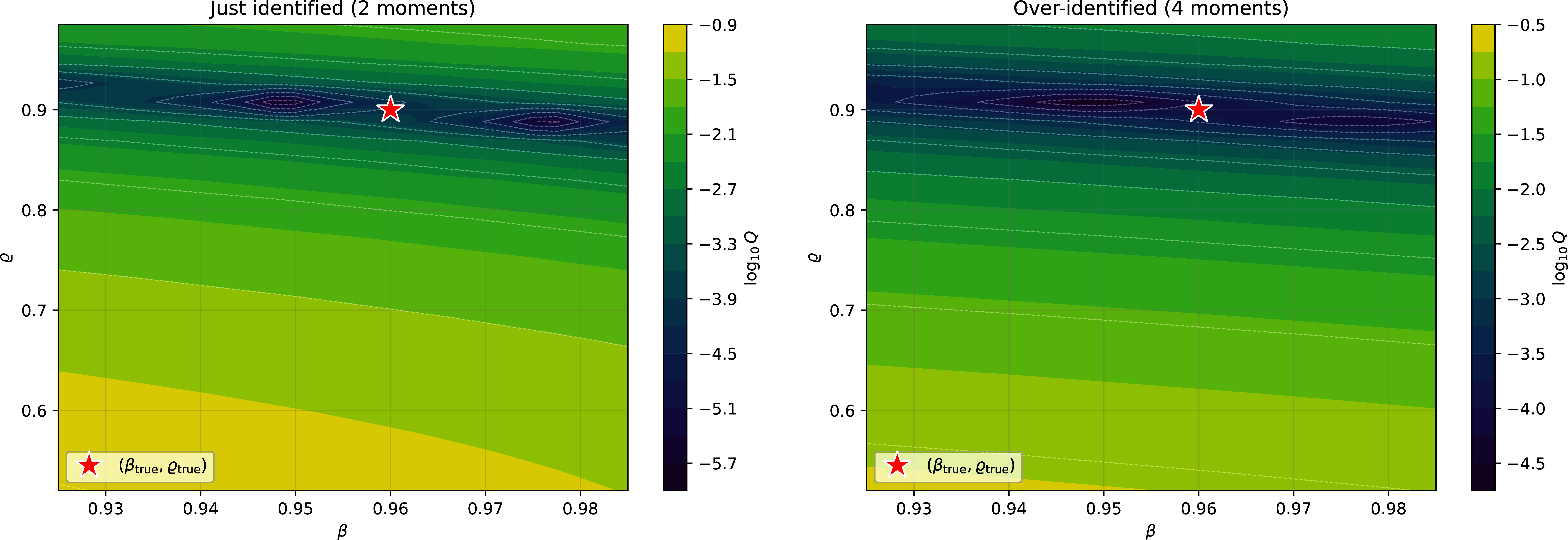
Figure 10.4:Direct SMM criterion for the joint Brock--Mirman estimation. The left panel uses the just-identified two-moment specification and displays a shallow ridge along , signalling that patience is only partially identified by those two moments. The right panel uses the over-identified four-moment specification, which adds volatility and output-persistence information and produces a localized minimum near the synthetic truth. Generated by notebook 03b.
In the research-scale extension, the second-layer GP fitted to the joint moment map provides a closed-form, microseconds-per-call substitute for forward simulation: subsequent SMM evaluations, bootstrap replications, and Bayesian post-processing run on the GP rather than on the simulator. The TikZ architecture diagram in Figure Figure 10.3 already encodes the cost cascade; the rendered GP-objective surface itself is not produced by the core notebooks and is therefore not displayed here.
10.1.5Beyond SMM: Indirect Inference and Simulation-Based Inference
SMM matches a hand-picked vector of moments. Two close cousins are worth knowing because they often dominate SMM when moment selection is awkward or when one wants the full likelihood.
10.1.5.0.1Indirect inference.
Smith (1993) and Gourieroux et al. (1993) replace the moment vector with the parameters of a tractable auxiliary model (e.g. a low-order VAR or a flexible regression) fitted to both the data and to model-simulated data. Estimation matches the auxiliary parameters rather than raw moments; the resulting estimator is asymptotically equivalent to ML when the auxiliary model is sufficiently rich, and the auxiliary parameters often summarize the distribution far more efficiently than a hand-picked moment list. Indirect inference is the natural choice in macro-finance applications where standard moments are weakly identifying but a structural VAR or a near-likelihood auxiliary is available.
10.1.5.0.2Simulation-based inference (SBI).
In settings where the simulator is differentiable or fast but the likelihood is intractable, modern SBI Cranmer et al., 2020 learns a neural conditional density estimator (or its likelihood/likelihood-ratio counterpart) directly from pairs simulated under the prior. The resulting object is an amortised Bayesian posterior usable for any future observation at cost of one forward pass. SBI generalizes Approximate Bayesian Computation, sidesteps moment selection entirely, and naturally pairs with the deep-surrogate machinery of Chapter Chapter 9. In the surrogate-then-estimate framing of this chapter, the most direct SBI variant is neural posterior estimation (NPE), where the pseudo-state DEQN provides the simulator and the GP moment surrogate of Section 10.1.4 is replaced by a learned posterior ; Exercise 10.4 contrasts SMM with SBI in algorithmic terms.
When to choose what. SMM remains the workhorse when a small number of structural moments are well-identified and economists want a transparent, interpretable objective. Indirect inference dominates when an informative auxiliary model is available. SBI is the natural tool in environments where the model is expensive to simulate but a one-time training run unlocks Bayesian inference at evaluation time, precisely the setting in which the rest of this script deploys deep surrogates.
10.1.5.0.3Why this matters for the next chapter.
Climate--economy integrated assessment models (Chapter Chapter 11) are the prototypical setting where surrogate-based estimation pays off. Credible policy analysis requires evaluating the model over many climate-sensitivity, damage-elasticity, and discount-rate scenarios. Treating the parameter vector as a pseudo-state and training a single deep surrogate, exactly as in the SMM exercise above, turns repeated re-solves into repeated forward passes and is the technical bridge between this chapter and the next.
10.1.6Further Reading
McFadden (1989) Pakes & Pollard (1989)Duffie & Singleton (1993), the foundational SMM trio.
Kase et al. (2022), neural-network estimation of nonlinear heterogeneous-agent models; Chen et al. (2026), deep surrogates for finance and option pricing.
Cranmer et al. (2020), contemporary simulation-based inference.
10.1.7Exercises
Worked solutions and guidance for these exercises appear in Appendix Appendix F.
A resource-based variant in which the savings rate is applied to total resources , allowing disinvestment relative to the depreciated stock, is a straightforward alternative; the SMM moments and notebook outputs in this chapter use the output-based savings rate above.
- McFadden, D. (1989). A Method of Simulated Moments for Estimation of Discrete Response Models without Numerical Integration. Econometrica, 57(5), 995–1026.
- Pakes, A., & Pollard, D. (1989). Simulation and the Asymptotics of Optimization Estimators. Econometrica, 57(5), 1027–1057.
- Lee, B.-S., & Ingram, B. F. (1991). Simulation Estimation of Time-Series Models. Journal of Econometrics, 47(2–3), 197–205.
- Duffie, D., & Singleton, K. J. (1993). Simulated Moments Estimation of Markov Models of Asset Prices. Econometrica, 61(4), 929–952.
- Gourieroux, C., Monfort, A., & Renault, E. (1993). Indirect Inference. Journal of Applied Econometrics, 8, S85–S118.
- Chen, H., Didisheim, A., & Scheidegger, S. (2026). Deep surrogates for finance: With an application to option pricing. Journal of Financial Economics, 177, 104222. https://doi.org/10.1016/j.jfineco.2025.104222
- Scheidegger, S., & Bilionis, I. (2019). Machine learning for high-dimensional dynamic stochastic economies. Journal of Computational Science, 33, 68–82. https://doi.org/10.1016/j.jocs.2019.03.004
- Kase, H., Melosi, L., & Rottner, M. (2022). Estimating Nonlinear Heterogeneous Agent Models with Neural Networks (CEPR Discussion Paper No. 17430). Centre for Economic Policy Research.
- Payne, J., Rebei, A., & Yang, Y. (2025). Deep Learning for Search and Matching Models (Techreport No. 25–05). Swiss Finance Institute.
- Kübler, F., Scheidegger, S., & Surbek, O. (2026). Using Machine Learning to Compute Constrained Optimal Carbon Tax Rules. Journal of Political Economy: Macroeconomics.
- Friedl, A., Kübler, F., Scheidegger, S., & Usui, T. (2023). Deep Uncertainty Quantification: With an Application to Integrated Assessment Models.
- Chen, X., & White, H. (1999). Improved Rates and Asymptotic Normality for Nonparametric Neural Network Estimators. IEEE Transactions on Information Theory, 45(2), 682–691. 10.1109/18.749011
- Chen, X. (2007). Large Sample Sieve Estimation of Semi-Nonparametric Models. In J. J. Heckman & E. E. Leamer (Eds.), Handbook of Econometrics (Vol. 6B, pp. 5549–5632). Elsevier.
- Chen, X., Christensen, T. M., & Kankanala, S. (2021). Efficient Estimation in NPIV Models: A Comparison of Various Neural Networks-Based Estimators. arXiv Preprint, arXiv:2110.06763.
- Scheidegger, S., & Treccani, A. (2018). Pricing American Options under High-Dimensional Models with Recursive Adaptive Sparse Expectations. Journal of Financial Econometrics. 10.1093/jjfinec/nby024